

Technology and Development
We build the software our own operations run on.
GPS Health Hub is a working product in the Sri Lankan insurance market, built and run by us. The same team builds custom software and AI-led products for clients.
01 / InsureTech
The GPS Health Hub
Sri Lanka's first digital platform for managing medical insurance claims.
A medical claim normally starts as paper at the discharge counter, days after the treatment it describes. The insurer, the hospital and the patient each hold a different part of it, and none of them can see the whole case at once.
The Health Hub opens the claim at admission instead, and keeps one shared record of it through submission, adjudication and settlement. GPS Health administers claims on that platform for insurers and hospitals, with a doctor panel on medical scrutiny and assessors who attend in person where a case calls for it.
What it does
- Real-time hospital admission tracking
- Instant claims submission
- Quick discharge settlements
- Digital claims management, end to end
Insurers
Faster adjudication, lower leakage, and a live view of every admission against the policy.
Hospitals
Admission confirmed and settlement agreed without the paperwork cycle that holds up discharge.
Policyholders
Claims submitted at the point of care, and discharge that is not delayed by a claim.
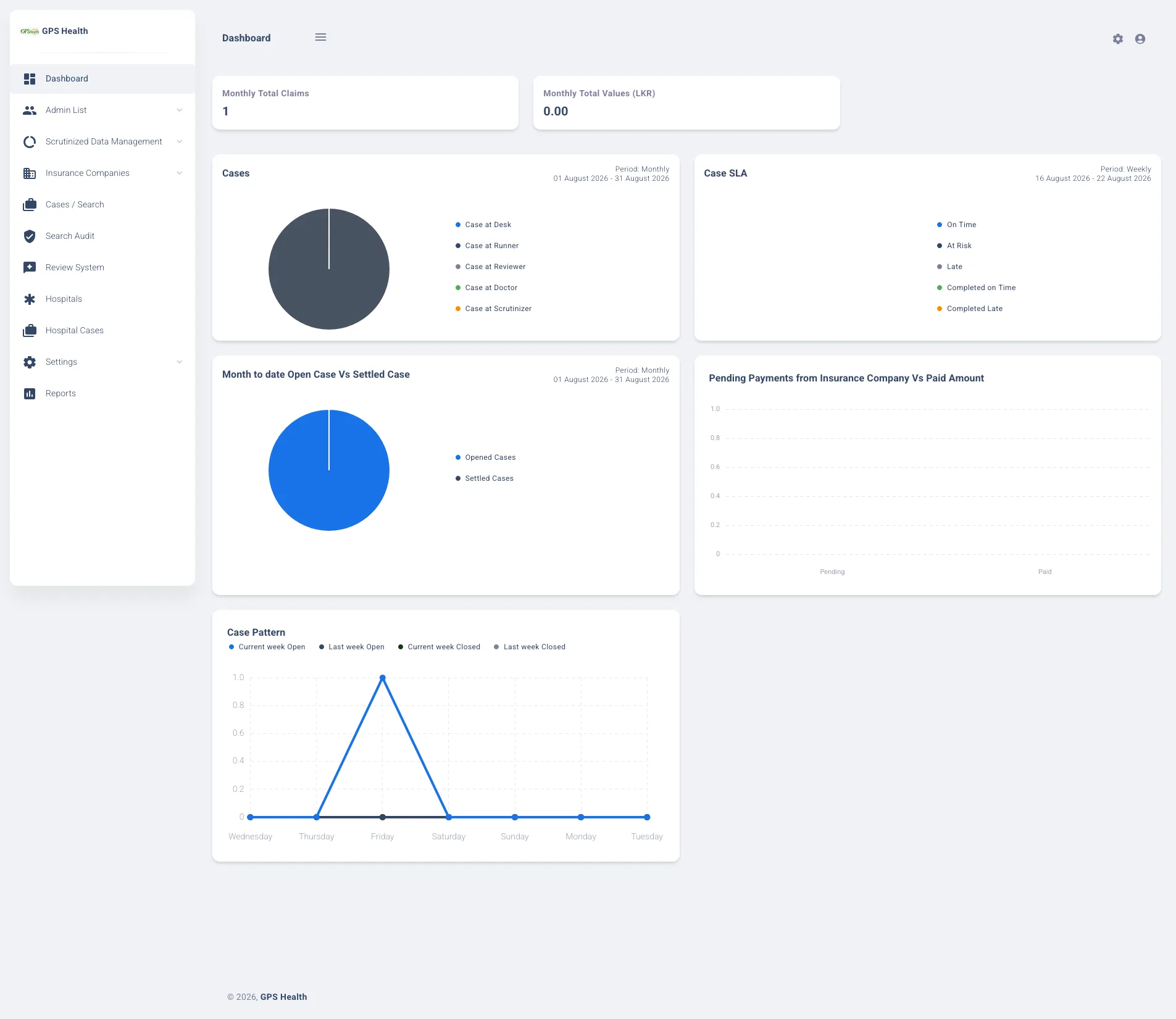
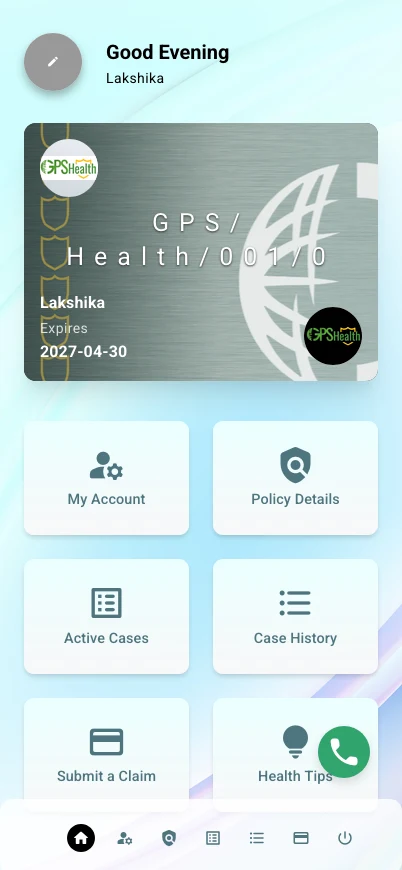
See the GPS Health Hub for yourself
The platform has its own site, covering the claims workflow, the hospital network and third-party administration in full.
02
Software development
Custom systems for organisations that have outgrown the spreadsheet and cannot find the process they run in any off-the-shelf product. Built the way we built our own.
Product strategy that starts in the domain
We come at software from the operations side. Before anything is designed we want to understand the process it replaces, who touches it, and what currently goes wrong.
Single-purpose systems
A tool that does one job properly beats a platform that does nine of them adequately. We would rather ship something narrow and finished than broad and perpetually nearly ready.
End-to-end ownership
Discovery, design, build, release and the running of it afterwards. The same team stays with the product, so nothing is lost in a handover to a support desk that was not there.
Engineers who work as part of your team
Where you have your own roadmap and need capacity, we place engineers into your team on your process, your board and your standards, rather than running a parallel project.
Web
React and Next.js
Mobile
Native iOS and Android
Infrastructure
Cloud hosted, deployed continuously
Integration
APIs into the systems you already run
What we build
The systems we are usually asked for
Bespoke work rarely starts from nothing. Most briefs are a version of one of these, with the difficulty in a different place each time.
Customer onboarding and journey platforms
Account opening, servicing and lifecycle journeys for banks, finance companies and insurers. The screens are the easy part. The work is the identity and due diligence checks, the referral paths when a file does not clear, and keeping a straight-through journey straight through.
Regulatory and compliance reporting
Returns that are assembled by hand from several systems on a deadline. Automating them removes the reconciliation each month and, more to the point, removes the chance of filing a figure nobody can trace back.
Institutional information management
Systems of record for ministries, universities and awarding bodies, where several organisations read the same record for different reasons, and the reporting obligation often sits outside the body that holds the data.
Collection and payment systems
Fare, fee and levy collection across many points and operators. Taking the payment is rarely the difficulty; settling, reconciling and evidencing it afterwards is.
Regulated asset and inventory tracking
Custody and movement records for controlled or high-value stock, where an entry must be attributable, time-stamped and hard to amend quietly, because an auditor or an inspector will eventually read it.
Document digitisation and records indexing
Retiring physical files and vaults into something searchable and access-controlled, with the retention rules and permissions built in rather than left to whoever holds the folder.
Sectors
Where this work lands
Most of what makes a build hard is not the technology. It is the rules the sector runs on: who has to sign, what has to be evidenced, and which system of record cannot be touched. These are the sectors we build against.
Banking and financial services
Core system integration, digital onboarding and customer journeys, and the reporting that sits behind them. The constraint is rarely the interface: it is the audit trail, the reconciliation, and proving to a regulator that the process did what it claims.
Fintech
Payments, lending and wallet products, where the first version has to be small enough to ship and structured enough to survive the second. We build for the integration surface and the exception paths early, because that is where these products age badly.
Government and public sector
Programmes that carry procurement rules, published requirements and long horizons. They are less about novel technology than about traceable requirements, workable data migration, and a system that still runs when the funding cycle ends.
Insurance
Claims administration, provider networks and the assessment workflow between them. This is the sector our own platform serves, so it is the one where we bring a working product rather than only a method.
Education
Student, institution and information management, where several bodies read the same record for different reasons and the reporting obligations sit outside the organisation that holds the data.
03
AI-led development
We run back offices for a living, so we are unusually well placed to see where a model genuinely removes work and where it only moves it. These are the rules we hold ourselves to.
Designed in, not bolted on
Where a model is part of the answer, it belongs in the architecture from the first design conversation. Retrofitting one onto a finished system usually produces a feature nobody trusts.
Pointed at real operational work
Document extraction, classification, reconciliation, triage and drafting: the repetitive judgement calls that fill a back office. We know that work because we do it.
A person on the decisions that matter
Automation handles the volume and routes the exceptions. Where a decision carries money, a medical outcome or a regulatory obligation, a person still makes it.
Measured before it is trusted
New capability is evaluated against the process it is meant to improve, on your data, before it goes anywhere near production.
Technical expertise
The stack we build on
The languages, platforms and tools our engineers work in. Enterprise Java and Spring through the middle, React and Node across the front end, AWS and Azure underneath, and applied AI on top of it.
Languages and frameworks
What the systems are written in.
 Java
Java C++
C++ Spring Boot
 Hibernate
 Node.js
 Express
 TypeScript
 JavaScript
 Python
 React
React Next.js
 Swift
Swift Kotlin
 .NET
.NETData and messaging
Where the record lives, and how systems talk to each other.
 PostgreSQL
 Oracle
 SQL Server
 MySQL
MySQL MongoDB
 Redis
Redis Apache Kafka
 RabbitMQ
Cloud, infrastructure and delivery
Where it runs, and how it gets there.
 AWS
AWS Microsoft Azure
 Docker
 Kubernetes
 Nginx
Nginx Linux
Linux Git
Git Bitbucket
 Maven
Maven Jira
Jira Confluence
 IntelliJ IDEA
AI frameworks and tools
Where a model is part of the answer.
 OpenAI APIs
 Claude Code
 Google Gemini
 LangChain
 LangGraph
 Hugging Face
 TensorFlow
 Cursor
AI specialisations
Architecture and method
Next step
Have a system in mind?
Describe the process, who uses it and what it has to talk to. We will come back with a scope, a build plan and a price.
Start a conversation